Friday, 23 August 2013

Souvenirs

Lovely but useless Murano glass.
It's not even real Murano glass!
When purchasing souvenirs on holidays, most of us lose our heads. We just want to capture the moment with something tangible – a little bit of sparkly magic we can cling on to when we go back to our routine lives. Even though we know, most of us know, that souvenirs are inevitably rubbish and carry no magical powers whatsoever. Oh no, we tell ourselves, I’m not buying plastic trinkets made with cheap child labour. Oh no, I’m going to buy something real, something authentic. Say, a tiny Murano glass figurine from Venice that costs half your shopping budget. That sits on the shelf. Collecting dust. Made exclusively for the tourist market.

I’ve bought a stack of useless things both for myself and for others, in the spirit of souvenir buying. In Canada I loaded up on bear poo (chocolate coated sultanas), maple leaf key rings and maple syrup soap, butter, candles and tea. In Spain I bought hand painted plates, in Russia I bought lacquered trinket boxes and in every country I’ve visited I’ve collected a pen, key ring, postcard and/or magnet. I bought $20 worth of bead jewellery in Brazil and paid $60 to get them treated at Customs.

I’m ashamed. I’m ashamed when purchasing my cheap Taiwanese import spoons at the counter, but tell me what else I can give my aunts. Let’s face it, they’re convenient and don’t take up any important space in your suitcase. In Hong Kong my niece actually spent seven days and nights searching for damn tea towels for her aunts. They were, incredulously, nowhere to be found. Cheap jewellery, pashminas, imitation handbags and purses aplenty. But tea towels, forget it. She ended up finding one at the airport as we were preparing to head home.

Perhaps my parents take the biscuit in terms of impractical souvenir buying. My Italian parents living in Australia visited their homeland in 1977. As gifts for themselves and other family members, they brought back with them four (that’s four) La San Marco espresso machines from Milan. Orange and chrome. Four. My father estimates a good 6 kilos each. In one suitcase. My parents were clearly well ahead of their time with regards to home espresso machines, but right up there in the ‘crazy’ category as far as souvenir buying is concerned.

I scrounged around for a photo of this coffee machine that used to sit in our kitchen. I failed to locate one, so I casually asked my aunt, one of the espresso machine recipients, if she had one. She had one better - the actual coffee machine, still in plastic. I took this photo last week. Needless to say, my aunt is a bit of a hoarder....

You think this is just a 21st century malady? Not so. On the Grand Tour in the 1700s the English hoards invading Italy packed up extraordinary booty to take home. Keep in mind, those on the Grand Tour were mainly male 20-somethings with money to burn and an aching desire to prove to those at home that they were now learned and cultured young men. They took home plaster busts and portraits of themselves sitting idly by classic Roman scenes. They carried off with them an enormous amount of sculptures, medals, paintings and books. Some of them started museums. Possibly the most disturbing to our modern sensibilities – they chipped off hunks of marble from the Roman Forum relics that they would later convert to a lovely coffee table.

But like us souvenir suckers today, the English regularly fell for fake antiquities. Enterprising Italians quietly rustled up some half decent marble Roman torso, scrounged up some suitable limbs and then tinted them all with tobacco water to age them consistently. ‘Come this way sir. Of course it’s real!’

I had my own Grand Tour / crazy souvenir moment when visiting Hobart in Tasmania. I walked into an antique map shop and stopped dead in my tracks. On the wall were four framed engravings of Rome in the style of Piranesi. They were at least half a meter in length and height. Each. They were straight out of the 1800s and I instantly fell in love with them. I recalled my parents epic journey with four coffee machines and thought, I can’t really buy four framed 19th century engravings can I? No, I decided, that’s too silly. My souvenir from Hobart will be restricted to fudge and chutney from the market. And maybe a hand painted bookmark. But no 19th century engravings.

Six months later, home in Adelaide, I was still thinking of those engravings. They called to me like no other souvenir ever had. (Except for maybe a pair of Prada sandals in a Hong Kong outlet store that I still dream about now and then). So I called the store and, yes, they were still available. A few days later I was hanging them on my office wall. Best souvenir I ever bought. 

One of my beautiful engravings. No regrets about this souvenir.


Monday, 5 August 2013

Beijing disconnect


Temple of Heaven


When I meet a new city, I’m so willing to fall in love with it. I try to give it a warm hug and ask it to bear its soul immediately. I’m demanding. When perhaps I should hang back a little and let it come out from behind the curtains in its own time.

I went to Beijing wide-eyed and eager to swoon but left feeling a little rebuffed and disorientated.

When my friend Michelle and I arrived, mid-November, mid-afternoon, the sun was an amazing golden ball, hazy but intense. It was cold. There was snow and ice on the ground and tree branches. The air felt crisp and fresh but surely that lovely hazy light was just pollution?

We were staying in a rather lovely hotel but it sat on a ring road – a vast, multi-laned ring road with no pedestrian crossing in sight. We gazed into the middle distance from our windows and wondered how anyone ever managed to get to the other side. There was an observation tower seemingly only meters away but after much deliberation we decided it just wasn’t worth risking our lives for.

Like the beacon in The Great Gatsby....
We took a short walk outside, laughing at the minus zero temperatures for the first few minutes, and then grimacing and struggling to inhale. We just wandered down the street and in and out of little shops. Certainly we didn’t feel unsafe, but the curiosity and interest from passers-by was not playful. It wasn’t tempered with the innocent joy of the unknown and the shy possibility of connection. It was, instead, a little suspicious and closed. Even though I tried to grin pleasantly at everyone (I admit, that may well have been the problem).

The communication breakdowns we found endearingly funny were just sources of consternation to service staff. At the hotel we ordered something like a Bailey’s on ice, and a vodka and lemonade. The waitress returned with a Black Russian and a Kahlua shot in a martini glass. But no smile.

Michelle and I took the inevitable Great Wall tour. It was only a small group – a very quiet Indian couple, and an American Chinese couple with elderly parents. Our Chinese guide, Eric, was lovely and engaging and helped us believe we could still fall in love. The tour group itself was from one of Dante’s circles of hell. The one were people responded to questions in monosyllables and didn’t bother to ask any in return. The one where people on holiday were depressed and depressing, uncommunicative and closed. These were folks who audibly sighed with joy and relief, and pounced eagerly, when fries were brought to the table at the end of an excellent Chinese lunch. Even, to my dismay, the elderly Chinese Americans.

Michelle and I drank all the alcohol at the table – our glasses, the Indian couples’, the elderly Chinese parents’ – and left to wait outside.  

Maybe it was the cold. Beijing was cold. The cold was sometimes unbearable. My fingers hurt, I couldn’t feel my face well enough to speak. I was standing, walking, waving but only because my brain was still functioning and sending the correct messages to my obedient limbs.

Finally we get to the Wall. It is an impressive and beautiful structure. It’s just a wall but it’s built across mountain tops and the idea of hundreds, thousands, of Chinese building this enormous monument by hand, brick by brick, of surviving winters in the dark and freezing watch towers is truly staggering. I struggled up the wall – icy steps and gale force winds. I lost my balance and slid to the ground. I stepped carefully and all the while thought of those who built and guarded it. What resilience, what fortitude. And what misery and despair they must have felt, surely.


The next day, our last in Beijing, I was restless and cantankerous. Like a selfish traveller I was looking for the familiar. I like to think it was in search of connection, but maybe it was just a comforting blatant search for the familiar. The city seemed soulless, the people hesitant. We had met a few warm people but we were kept at a distance. When I like to be close. Of course, that’s my problem, not any other nation’s.

So we headed for the Forbidden City and the Temple of Heaven. You can find any information you like on both of these astonishing places – go look for it if you like – but not just yet. In a moment. Because one of the most interesting episodes for me was the walk through the park to get to the Temple of Heaven.

Here was life. A sheltered gallery where groups huddled together playing cards, slapping them down, jeering and triumphant or frowning and defeated. There was karaoke – a serious looking sing-off between two men. Another woman putting her whole heart into her song and all the expression into her face.

And then there was an open air ‘disco’. I love music and I love to dance. So I watched transfixed at a group of folks gathered together in an open space in the park. All these people, young and old, dressed in heavy coats, moved in various ways to loud speaker music. It was 3 o’clock in the afternoon. Sunday. Minus 8 degrees. A middle-aged couple danced a tango so gracefully and beautifully you’d think they were competing. They were so earnest and light at the same time (remember, minus 8). Everyone was beaming, content and patient. It wasn’t a wild party; it was a sedate but passionate appreciation of dancing and music.

I smiled. I smiled and smiled. Strange how these few minutes influenced all my perceptions. I knew this, I knew dancing. And I knew community, and togetherness and warmth when I saw it. Even if I didn’t necessarily feel welcome to join in, that was ok. I’d witnessed it. That was enough to connect.

Even if just for a moment, only connect.


Sunday, 21 July 2013

We’re not in Kansas anymore: Orchard Towers, Singapore

Boat Quay

It was around 2.00am on a Monday, Post-Formula 1 Grand Prix Sunday, and Boat Quay was peppered with drunk Western tourists. Yes, that’s right, I was one of them. Race fans were still milling about, promenading up and down the Quay. A tall bunch of Europeans wore red curly wigs and heaved around an enormous Ferrari flag that they used to wrap around and capture passers-by. We merrily took photos of each other and promised to email them. (No, I never received any.)

‘We’ included a friend of mine from the UK and her friend, and a fellow Aussie we met at the track – let’s call him Shane. I don’t think we were too obnoxious – we didn’t skip and dance in the street and we didn’t shout out obscenities. We just sat in the charming English pub, the Penny Black, giggling like school kids and trying to make new friends (I managed to chat to a special effects guy working on the movie Rush).

But then the Penny Black had to close and we were turfed out. We walked past the singing Europeans again, took more photos but then extracted ourselves and continues down the street. Singapore is always balmy and summery and even though the streets were almost empty by then, we were keen on continuing the revelry and celebration. But where?

The street back from Boat Quay was also full of bars and nightclubs – all closing or closed. Out options were down to a couple of strip clubs but we three girls roll our eyes and said no. Yuk. I don’t think so, thank you.

Fancy then, our naivety when a local suggested (coyly, I might add) that we were sure to find something open at Orchard Towers and we gaily thanked him (him) jumped into a taxi and headed straight there.

I didn’t know. I didn’t know that Orchard Towers was a shopping centre by day and a multi-story whore house by night. I didn’t know that it was bar after club after bar after disco of prostitutes – both the regular and lady-boy kind. I didn’t know.

We spilled out of the taxi and were confronted with Orchard Towers. It took us two minutes to scan the scene before we had that ‘I don’t think we’re in Kansas any more Toto’ moment. I think Shane had a moment of ‘How do I behave in polite company?’. We didn’t even make it inside the actual building, but opted for a bar on the ground floor. I wish I could tell you its name (only so you can avoid it) but I didn’t take note. In fact, we didn’t even make it inside that bar either, but sat on the balcony. I only know we were determined to have one more drink, enjoy the unique ‘atmosphere’ and then call it a night.

We continued to grin and snort with laughter while we clambered on to our tall bar stools and gave drink orders to scantily clad hostesses. Shortly after our first vodka and lemonade, I hit the dance floor because I didn’t know what else to do. Inside the bar it was almost pitch black. It was pretty much empty and so was the dance floor. But soon enough three or four girls came to join me and we jumped crazily about for three and a half minutes. That was enough dancing for me.

I found my way through the gloom to the toilet which was, in contrast, starkly lit. A shame. Because I was confronted with everybody’s handbags, shoes, make-up bags, sparkly tops, stockings and hair brushes. The bin was overflowing with filth, and the walls were spattered brown and red.

Back at our table, my friend was chatting with one of our hostesses. She was sweet and young-looking. Exactly as you would imagine this girl to look – innocent, petite and fragile. She was from the Philippines (let’s call her Jessie) and kept asking us if we were having fun, needed any more drinks, wanted to dance any more. Her ‘boss-lady’ kept circling us and smiling but with narrowed eyes and a stern look. She seemed to make Jessie nervous and twitchy so we tried to look as if we were indeed interested in ‘business’ and bought her a drink. Shane was no help at all. Wide-eyed and surely confused about what he should do and how he should behave in the company of women, he did nothing but grin uncontrollably. Disturbing.

We were joking around and still tittering but then, suddenly serious, my friend said to Jessie, ‘There’s got to be something else you can do? What about cleaning?’. Jessie was a little defensive – ‘It doesn’t pay as much, and it’s so dirty’. We raised our eyebrows. I honestly don’t think she realised the irony in that statement.  She told us she only had a few weeks left on her contract anyway and that she would be heading home after that. Jessie sent her money home to her family. ‘Sure’, my friend said, ‘but....’. She was struggling to understand, as were we all. How do we connect? I looked at Jessie and said, ‘We will do a lot for our family, won’t we?’. And she looked back at me, cocked her head and said, with an indignant but grateful tone, ‘Thank you. Yes.’. She seemed on the verge of tears. Which wouldn’t be good for business.

Her boss came round again and said something to her. Jessie moved on to another table where a couple of completely wasted and ripe Westerners teetered on their stools.

We decided to call it a night and called out for a taxi. We had stopped laughing.

Sunday, 9 June 2013

Brazilian F1 Grand Prix

Fans flying the flag
So, my dad and I being long time fans of Formula 1, we thought, while we were in Brazil, we should catch the race. It was Michael Schumacher’s last race (the first time, 2006). Why not. We had done every grand prix in Adelaide and even a couple in Melbourne. Sao Paolo seemed like the next logical step.

I’m going to have a whine about it. That’s right, a first-world whine.

Lost

Our adventure started at the hotel. We were unsure of where we were going and how long it would take to get to the track (despite rather extensive research!) because there was no circuit information available in English. So when I spied a fellow milling about the hotel foyer with a Ferrari cap and knapsack I quietly idled by a pot plant and waited. When a taxi arrived for him, I swooped. Before this poor fellow could get in the front and shut the door, my father and I were halfway in the backseat on each side and I’m smiling winningly and pointing to my F1 entry pass. Dad and I shut the doors, pulled on our seatbelts, smiled again and waited. The totally frazzled fellow at the front spoke Portuguese to the driver and away we went. We never actually confirmed we were going to the same place but it worked out well.

Beyond the cyclone fencing and metal poles,
there is a Ferrari. I promise.
 Street circuit vs race track

We quickly realised the difference between street circuits (Adelaide, Melbourne, Monaco, Singapore) and a dedicated race meet at a purpose built circuit. It was hard to describe what was there. It’s easier to describe what was not there – no lattes, strawberries and ice-cream, no fashion parades, live bands, parachutes or stunt bikes. There was the race. There were very bad hot dogs sprinkled surprisingly with potato chips and there was overly frothy beer. You had to buy a ticket at one stall and then collect your food at another, which was fine if you spoke Portuguese (surprisingly, actually, how quickly you learn the words for ‘beer’ and ‘sandwich’.). There was a single stand selling Ferrari gear and a couple selling Renault. That’s all. Unfortunately, there was also so much cyclone fencing between any vantage point and the track that I almost went blind.

Brazil = party atmosphere: wrong

Sure, we watched the cars zoom down the Senna S curve. Sure, the qualifying was exciting, Massa got pole and went on to win. Yeah, yeah it was Schumacher’s last race (started 10th, dropped to last, and then finished 4th). This is not a racing report. Don’t get me wrong – I’ve followed F1 since I was 12 and I’ve diligently watched every race live ever since (well, let’s say 90%). I can tell you what the DRS system and KERS is all about. But I was in Brazil! At an F1 motor race! And I was cold and bored and hungry! Where was the excitement? The glamour? That’s right – dad and I were disappointed. We were downright grumpy and narky with disappointment. We had to buy umbrellas and coats! Where was the glorious Brazilian sunshine? Where was my actual seat for crying out load? All I had was a wooden slat!

Abrupt start / abrupt finish

Whilst my father and I wandered into the circuit on the first day chattering and excited like kids at a birthday party, we soon became bored and disconsolate. There were very few support races, very few English / Italian speakers in the stands to chat with, very little will to sit on our wooden slat for too much longer. I suggested we wander around outside a little and see what the neighbourhood was like (the circuit sits snugly within an ordinary suburb). But upon trying to leave we were pounced upon by an aggressive female security guard who kept saying ‘No, no!’ and shaking her head sternly. Um?? Eventually she managed to indicate that if we left, we would not be allowed to re-enter the circuit until tomorrow.  We didn’t want to miss the actual reason we were there – F1 Friday Free Practice – so, we slunk back to our seats, feeling a little like prisoners. A feeling that was reinforced by the cyclone fencing.

After the race, when my new circuit friend Jackie, possibly Schumacher’s biggest fan (after all, she flew in from Newcastle, UK, for only three days), stopped sobbing hysterically, we sighed, hugged and prepared to listen to the drivers at the after race press conference. But even that was thwarted! A line of reckless- and edgy-looking policemen started at one end of our grandstand and systematically swept everyone out before the champagne cork popped. For goodness sake – what about this legendary atmosphere? Where’s the sense in turning out 80 000 people all at once? Taxi! Taxi!!!????? Another fellow we’d met at the track (an English-speaking Brazilian from Fortaleza) herded us away and encouraged us not to provoke the policemen. ‘You never know’ he said.
 

Happy ending

There was a happy ending of course. We caught a bus into town with the other 80 000 folks and then asked a taxi driver to take us to a good Italian restaurant. We were deposited at Lellis and ordered various mountainous platters of pasta to share.  We were like a good joke. An Australian, an Englishman, an Italian and a Brazilian walked into a restaurant.... 

And after all, the point for me was not that I was witnessing Schumacher’s last race, or that I was watching the F1 in Sao Paolo, Brazil. It was the fact that I was sharing it was my dad (see Sao Paolo, Brazil via the 1950s) – something pretty special to me, despite my first-world whining.


Saturday, 20 April 2013

A Coeliac* in Hong Kong

Challenging. It was definitely challenging. You couldn’t go to Hong Kong as a shy and conservative Coeliac. You have to go in there hard with your translation card and winning smile at the ready. I’ve already noted how rare a disease gluten-intolerance is in Asia (see A Coeliac in Singapore) so I had braced myself for some interesting encounters and conversations.

The translation card

The little scrap of paper with the crucial explanatory text in English and Mandarin was more important to me than my mangy old passport. This was the golden ticket to dinner. It explained what I could and couldn’t eat. I researched a few before I found one that was straightforward and tactful. Someone online had made their own which was quite alarmist. Something along the lines of: ‘Please don’t hurt me. Please have a detoxification shower before preparing my food. Please don’t hurt me. And by the way, I can’t eat wheat.’

The reactions

My favourite reaction was a wonderful waitress in a tiny side street diner who read through my translation card, smiled broadly and nodded and then said to me in English, ‘A-ha! You’re one of those! I’ve heard about you’. My niece and I had the best rice noodles with pork, scrambled eggs (with toast for my niece) and a cup of lemon tea for the grand sum of AUS$4. I wanted tea with milk but after re-reading my translation card the waitress decided that no, she would not risk it – tea with lemon or plain hot water. Who was I to argue!

(As an aside, my niece would continue to proclaim joyfully and randomly throughout our trip: ‘$4!!!’ I even received a text recently, weeks after our holiday, reminding me that it was sooooo great to have breakfast, with coffee/tea, for just $4. Particularly as she had just paid AUS$12 for two coffees in Melbourne!)

The production number – bring out the dancing girls!

Every time I whipped out my translation card I carefully watched the face of the reader. There was inevitably a frown, a twitching of the mouth, a polite retreat, a conversation with someone more authoritative, some discreet finger pointing and more frowning and shaking heads. These beautiful folks seemed anxious about feeding me something that would consequently make me sick and so were super cautious. Rarely would I get turned away – more often than not the chef would be dragged out to have a chat and three people would be gathered round discussing what on earth I could eat. Hence the need to be confident and expressive – otherwise, I wouldn’t have eaten anything in Hong Kong. And it was so very worth the production number. There was always one little dish I could eat that brought satisfaction to all involved, particularly me.

Helpful folks

I really wanted my niece to try dumplings. (She really wanted to try them too!) There was no conceivable way I was going to find anything to eat in this heavenly floury place but I noticed some rice noodles on the menu and thought I might be able to wrangle a soup. Well, this was the only place that really couldn’t seem to accommodate me, but not for lack of trying. Again, a plethora of people were dragged in to nut out some options. No, nothing. I was completely happy with that, no problem, please don’t bother, it’s all ok – my niece is happy. Not content with that, the waitress wandered over to a regular who was with a Western looking fellow and pointed at me, slightly distraught. He smiled and said hello to me across the crowded cafĂ© and shouted gently ‘what seems to be the problem?’. No problem at all I said. I’m gluten intolerant, I thought I might get some rice noodle soup but no luck. He laughed good naturedly, ‘Lady, you are in the wrong place to eat!’. All good. The waitress continued to eye me sadly and shake her head now and then so I made a super effort to smile and laugh and not salivate impolitely and desperately over my niece’s heaped steaming plate of dumplings. I always carry a nut bar for such occasions.
 
Worth another visit? Hell, yes!

Hong Kong was a tricky but delicious place to eat. I scoffed lobster at Jumbo, had the most exquisite meal of my life at Amber (see Two girls and a two star Michelin restaurant), and still sigh fondly about that memorable $4 pork and noodle dish. I shunned all Western outlets (except for a brief fling with a Hard Rock Cafe in Macau) and tried as many local options as possible. It’s a little like Russian roulette with potential cross-contamination issues, but hell yes, I’d play again!

_______________________________ 

If you're after some suggestions (ie. restaurant names/ addresses) please feel free to email me at tmorganella@hotmail.com. 

*What is Coeliac disease?

In people with coeliac disease the immune system reacts abnormally to gluten (a protein found in wheat, rye, barley and oats), causing small bowel damage. The tiny, finger-like projections which line the bowel (villi) become inflamed and flattened. This is referred to as villous atrophy. The surface area of the bowel available for nutrient absorption is markedly reduced which can lead to various gastrointestinal and malabsorptive symptoms.

This extract has been sourced directly from the Coeliac Australia website (http://www.coeliac.org.au)


Friday, 5 April 2013

Casino! A 'why/how to' for solo travellers


The Venetian, Macau
Casinos. You either love them or hate them. On the one hand, yes, they can be depressing depositories of crass, desperate, lonely and dejected people. On the other hand – hear me out – they can be the epicentre of light-hearted fun, frivolity and even a little bit of magic. That’s right, magic.

One thing I can say for sure, casinos have often featured somewhere in my solo travels, and have often been, dare I say it, a beacon of (neon) light on a dark and lonely horizon. Especially on those evenings when you’ve done all the sightseeing you possibly could and suddenly you’re staring at the four walls of your downtown hotel and it’s only 7.30pm. Sure, there’s the theatre and the movies, and a glass of wine whilst reading a book in a quaint pub. Sure. I’ve certainly undertaken all of those activities on my own and thoroughly enjoyed them. Sure. Or ...

... there’s the casino. On the one hand, you can sit quietly by a roulette wheel for hours without anyone really bothering you or asking you to order a drink or get out. Contented alone time but amongst real people and life. Just avoid eye contact and no one will try pick you up either. On the other hand the casino is also full of lots of friendly folk who are willing to chat and for a champion chatter like me, that’s a lovely bonus. Casual gamblers the world over like to compare notes, see how you’re faring, ask where you’re from and generally smile and are pleasant. (Note: serious gamblers do not.)

‘What else’, you ask? Well, you don’t actually have to gamble. Casinos always have free entertainment and cheap drinks. You can listen to a band, watch performers, enjoy magicians all while contentedly sipping $5 gin and tonics. Do you like dancing? There’s usually a free bar to do that in as well. The dance floor is usually packed – no one will notice that you’re bopping along on your own. Empty dance floor? Pretend you’re drunk and dance anyway!

There are, however, some pitfalls you should be aware of. Crowne Plaza Casino, Canberra for instance.

This casino (and I’ve been to quite a few!) unfortunately holds the honour of being possibly the most glum and tragic casino in the world. One big empty room with signs and information about entertainment but no actual entertainment. High minimum bets and burly, surly looking staff. If there had ever been any fun or magic in this casino it died a long time ago. In the dim lighting you could clearly see the silhouettes of slumped shoulders and hung heads. It’s possible no one had ever won anything in this casino. Ever. It had a funereal air and certainly had the capacity to suck the life out of any unfortunate person who accidently and blindingly stumbled inside it unwittingly.

Stay clear of those casinos. They will only make you feel more wretched and lonely/ homesick.

And there’s also a little thing I like to call ‘The Witching Hour’. At around 11pm, especially on a Friday or Saturday night, a group of tipsy 18 year old ‘men’ will somehow stumble past security and gaze around in awe. It’s usually a first or second visit and they swagger up to the roulette table with no clue whatsoever, nudge each other and say things like, ‘Oi, can you put something on the zero?’. They proceed to spill their drinks, bump into everyone at the table and generally make crass jokes and giggle like school girls. I have watched one of these witching hour heathens dig deep into his pockets and pull out about $8.50 worth of change and slam that onto the table proudly (next to the flurry of $100 bills). ‘Put it all on black!’, he cries with gusto. He is inevitably drily told that the outside bet is a $10 minimum at which point his kind friends rustle up a $2 coin and wait with baited breath as the wheel spins.

Red.

‘Ah, this game is shit!’. He just resists kicking the table and walks away disgusted.

Look, the witching hour kids can be entertaining in their own way. As long as you don’t get beer on your dress.

But back to the positives! Even if you’re not travelling solo, what a great way to spend some alone time even whilst with your companion! You’re in the same place, at the same time, you can still talk about the experience together, but you can, if you choose, just sit at the bar quietly having a drink on your own while they play Blackjack. A moment of peace and silence. Ahhhh.....

And casinos may even save you from natural disasters! In Singapore I was stuck in a resort while a torrential and frightening storm raged outside. Every room in this hotel, including shops, cafes, and bars, was floor to ceiling glass so that every flash of lightening struck me with the fear of God and imminent catastrophe. Except the casino. Comforting with its lack of any windows and reassuringly dim lighting, I peacefully and repeatedly played zero at the roulette wheel until all danger had passed and I was able to emerge an hour later in blissful calm and tranquillity.

Too much?

Ok, well visiting casinos on holidays is not everyone’s thing. I’m just saying – if you find yourself yawning before the sun has gone down and with an hour or two of evening time to fill, it’s there if you need it!

Saturday, 23 February 2013

Sao Paolo, Brazil via the 1950s


My Italian father lived in Sao Paolo, Brazil for five years in the 1950s. He was in his early 20s and travelling with a posse from his village scrounging for work. A long way to go for work.

On the eve of his 74th birthday my father found himself wandering through the city, shaking his head in wonder, all over again.

As I saw it, Sao Paolo city centre was a seething mess of people. The city was so big it was too difficult to see the details – just general impressions. To me the city was alive and sharp. We walked along the wide thoroughfare Avenida Sao Joao which swings close by to the impressive city square, Praca di Repubblica. There were shops and opportunistic migrants selling their sunglasses and watches on the street. There were orange overalled cleaners trawling the footpaths and a magazine stand on every corner. Tall slim palm trees stood side-by-side with old fashioned wrought iron street lamps. Banana, mango and pineapple stalls cast a delicious sweet smell and everywhere people, people, people: those who were immaculately dressed with expensive watches, and those without limbs, scraping along on old skateboards.

But to my father the city was sadly empty and vaguely disappointing. He shook his head and painted a different picture for me: in the 1950s Avenida Sao Joao was open to street traffic and on hot summer nights the footpaths pulsed with young people like him chatting, drinking or heading to the popular Marocco cinemas. Too hot and tropical to stay indoors, people spilled out of doorways and wandered aimlessly, happy to be in the company of friends, even if none of them had any money to do anything. The thrum of cars competed with the noise of shouting, laughing and music. I pictured this scene in black and white. I imagined pomade and cigarettes, and crisp, clean shirts, even if the shirt was the only one the wearer owned.  

Barra Funda
We decided to find the house he had lived in, in a suburb called Barra Funda. My father wandered down the road, eyed his surroundings, crossed a street and smiled: he had found his bus stop and incredibly, the bus he used to take home still made the same journey. Twenty minutes later we find Barra Funda and more dismay. He finds an inner city suburb with empty shopfronts  and cheap housing. The corner store no longer exists and again, there is a distinct lack of people. He told me the corner store was the neighborhood hang out and every night the streets had hummed with activity. Now it was looking rundown and tired. No one would hang out on the corner after dark catching up on the daily gossip.

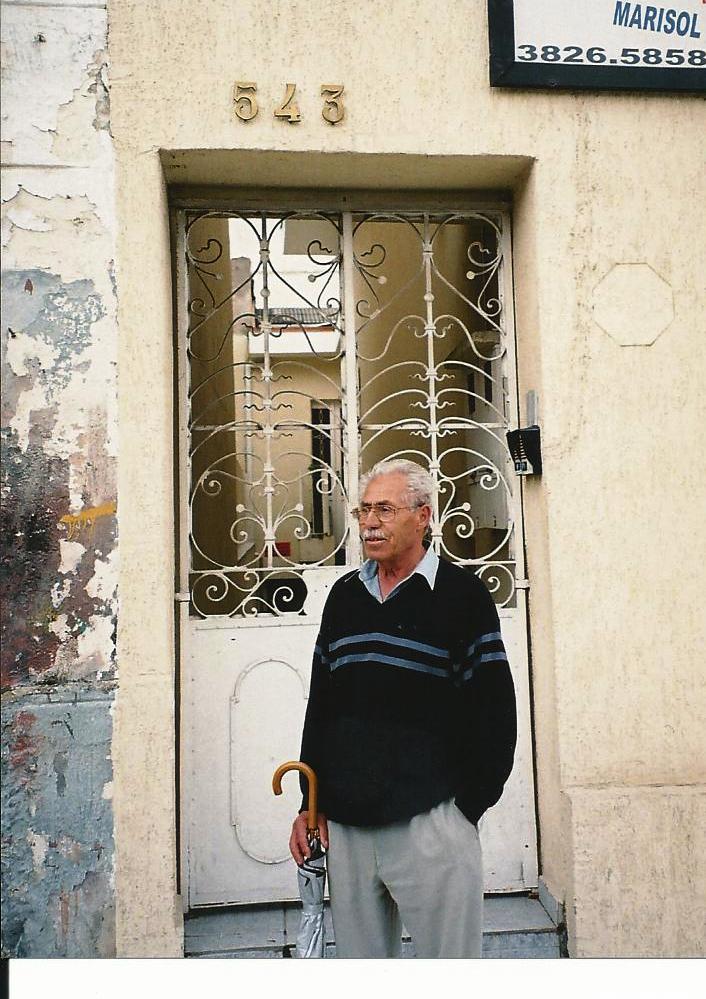
But at number 543 we stop and he smiles again – this is the entrance to his house. Just a white door with decorative iron panels. We were so tempted to ring the door and ask to look around but neither of us had the courage. It was enough just to be there.

He smoked a cigarette and was thoughtful for a moment. I tried to take photos quietly and unobtrusively, of the street, of the surroundings and of my dad. But it felt vaguely like taking pictures of the gravestones at a cemetery.  

Back in the city centre, in a crowded corner of the Praca di Repubblica, stands the Edificio Italia. It was built to honour the thousands of Italian immigrants who contributed to the wealth of Sao Paolo and hosts the Circolo Italia – the Italian Club.  The foundations of the Edificio Italia, second tallest building in Sao Paolo (46 floors), were being laid just as my father was preparing to leave Brazil. He had always wanted to see the finished product. Now we entered this stylish tower, still modern-looking some 50 years later, and took the elevator to the observation deck. We looked out over 11 million people. Cream, brown and grey buildings as far as the eye could see. Snippets of green but otherwise a vast city in its full concrete, bitumen and plate glass sense.

From this high point of view the city was breathtaking in its own way but not, I would say, beautiful. ‘Overwhelming’ perhaps fits better. Could I imagine arriving as a 20 year old, without knowing the language, without any idea of where to go, who to see and what to do to find work? Without any money, any life experience. Confronted by hundreds, thousands of people and all the associated commerce. It was a sobering thought. Despite the excitement, the thrill of foreignness, of being free from the domestic and sedate life my father had led in a small hillside village, it had to have been terrifying and overwhelming. The pleasure of ogling sophisticated beauties in pencil skirts must have been tempered with nagging thoughts about how he was going to eat the next day.

I quizzed my father – was he disappointed? Perhaps he shouldn’t have come back? There are plenty of schools of thought which tell you, don’t go back, don’t look back.

No, no he wasn’t disappointed. He was melancholy, tired, a little disorientated by the travel. But he was relieved he’d seen Sao Paolo again. It satisfied his curiosity. Perhaps it made his memories far more vibrant and coloured for a moment too.

And now he had a new story to tell of his time in Sao Paolo.