Showing posts with label Sao Paolo. Show all posts

Sunday, 9 June 2013

Brazilian F1 Grand Prix

Fans flying the flag
So, my dad and I being long time fans of Formula 1, we thought, while we were in Brazil, we should catch the race. It was Michael Schumacher’s last race (the first time, 2006). Why not. We had done every grand prix in Adelaide and even a couple in Melbourne. Sao Paolo seemed like the next logical step.

I’m going to have a whine about it. That’s right, a first-world whine.

Lost

Our adventure started at the hotel. We were unsure of where we were going and how long it would take to get to the track (despite rather extensive research!) because there was no circuit information available in English. So when I spied a fellow milling about the hotel foyer with a Ferrari cap and knapsack I quietly idled by a pot plant and waited. When a taxi arrived for him, I swooped. Before this poor fellow could get in the front and shut the door, my father and I were halfway in the backseat on each side and I’m smiling winningly and pointing to my F1 entry pass. Dad and I shut the doors, pulled on our seatbelts, smiled again and waited. The totally frazzled fellow at the front spoke Portuguese to the driver and away we went. We never actually confirmed we were going to the same place but it worked out well.

Beyond the cyclone fencing and metal poles,
there is a Ferrari. I promise.
 Street circuit vs race track

We quickly realised the difference between street circuits (Adelaide, Melbourne, Monaco, Singapore) and a dedicated race meet at a purpose built circuit. It was hard to describe what was there. It’s easier to describe what was not there – no lattes, strawberries and ice-cream, no fashion parades, live bands, parachutes or stunt bikes. There was the race. There were very bad hot dogs sprinkled surprisingly with potato chips and there was overly frothy beer. You had to buy a ticket at one stall and then collect your food at another, which was fine if you spoke Portuguese (surprisingly, actually, how quickly you learn the words for ‘beer’ and ‘sandwich’.). There was a single stand selling Ferrari gear and a couple selling Renault. That’s all. Unfortunately, there was also so much cyclone fencing between any vantage point and the track that I almost went blind.

Brazil = party atmosphere: wrong

Sure, we watched the cars zoom down the Senna S curve. Sure, the qualifying was exciting, Massa got pole and went on to win. Yeah, yeah it was Schumacher’s last race (started 10th, dropped to last, and then finished 4th). This is not a racing report. Don’t get me wrong – I’ve followed F1 since I was 12 and I’ve diligently watched every race live ever since (well, let’s say 90%). I can tell you what the DRS system and KERS is all about. But I was in Brazil! At an F1 motor race! And I was cold and bored and hungry! Where was the excitement? The glamour? That’s right – dad and I were disappointed. We were downright grumpy and narky with disappointment. We had to buy umbrellas and coats! Where was the glorious Brazilian sunshine? Where was my actual seat for crying out load? All I had was a wooden slat!

Abrupt start / abrupt finish

Whilst my father and I wandered into the circuit on the first day chattering and excited like kids at a birthday party, we soon became bored and disconsolate. There were very few support races, very few English / Italian speakers in the stands to chat with, very little will to sit on our wooden slat for too much longer. I suggested we wander around outside a little and see what the neighbourhood was like (the circuit sits snugly within an ordinary suburb). But upon trying to leave we were pounced upon by an aggressive female security guard who kept saying ‘No, no!’ and shaking her head sternly. Um?? Eventually she managed to indicate that if we left, we would not be allowed to re-enter the circuit until tomorrow.  We didn’t want to miss the actual reason we were there – F1 Friday Free Practice – so, we slunk back to our seats, feeling a little like prisoners. A feeling that was reinforced by the cyclone fencing.

After the race, when my new circuit friend Jackie, possibly Schumacher’s biggest fan (after all, she flew in from Newcastle, UK, for only three days), stopped sobbing hysterically, we sighed, hugged and prepared to listen to the drivers at the after race press conference. But even that was thwarted! A line of reckless- and edgy-looking policemen started at one end of our grandstand and systematically swept everyone out before the champagne cork popped. For goodness sake – what about this legendary atmosphere? Where’s the sense in turning out 80 000 people all at once? Taxi! Taxi!!!????? Another fellow we’d met at the track (an English-speaking Brazilian from Fortaleza) herded us away and encouraged us not to provoke the policemen. ‘You never know’ he said.
 

Happy ending

There was a happy ending of course. We caught a bus into town with the other 80 000 folks and then asked a taxi driver to take us to a good Italian restaurant. We were deposited at Lellis and ordered various mountainous platters of pasta to share.  We were like a good joke. An Australian, an Englishman, an Italian and a Brazilian walked into a restaurant.... 

And after all, the point for me was not that I was witnessing Schumacher’s last race, or that I was watching the F1 in Sao Paolo, Brazil. It was the fact that I was sharing it was my dad (see Sao Paolo, Brazil via the 1950s) – something pretty special to me, despite my first-world whining.


Saturday, 23 February 2013

Sao Paolo, Brazil via the 1950s


My Italian father lived in Sao Paolo, Brazil for five years in the 1950s. He was in his early 20s and travelling with a posse from his village scrounging for work. A long way to go for work.

On the eve of his 74th birthday my father found himself wandering through the city, shaking his head in wonder, all over again.

As I saw it, Sao Paolo city centre was a seething mess of people. The city was so big it was too difficult to see the details – just general impressions. To me the city was alive and sharp. We walked along the wide thoroughfare Avenida Sao Joao which swings close by to the impressive city square, Praca di Repubblica. There were shops and opportunistic migrants selling their sunglasses and watches on the street. There were orange overalled cleaners trawling the footpaths and a magazine stand on every corner. Tall slim palm trees stood side-by-side with old fashioned wrought iron street lamps. Banana, mango and pineapple stalls cast a delicious sweet smell and everywhere people, people, people: those who were immaculately dressed with expensive watches, and those without limbs, scraping along on old skateboards.

But to my father the city was sadly empty and vaguely disappointing. He shook his head and painted a different picture for me: in the 1950s Avenida Sao Joao was open to street traffic and on hot summer nights the footpaths pulsed with young people like him chatting, drinking or heading to the popular Marocco cinemas. Too hot and tropical to stay indoors, people spilled out of doorways and wandered aimlessly, happy to be in the company of friends, even if none of them had any money to do anything. The thrum of cars competed with the noise of shouting, laughing and music. I pictured this scene in black and white. I imagined pomade and cigarettes, and crisp, clean shirts, even if the shirt was the only one the wearer owned.  

Barra Funda
We decided to find the house he had lived in, in a suburb called Barra Funda. My father wandered down the road, eyed his surroundings, crossed a street and smiled: he had found his bus stop and incredibly, the bus he used to take home still made the same journey. Twenty minutes later we find Barra Funda and more dismay. He finds an inner city suburb with empty shopfronts  and cheap housing. The corner store no longer exists and again, there is a distinct lack of people. He told me the corner store was the neighborhood hang out and every night the streets had hummed with activity. Now it was looking rundown and tired. No one would hang out on the corner after dark catching up on the daily gossip.

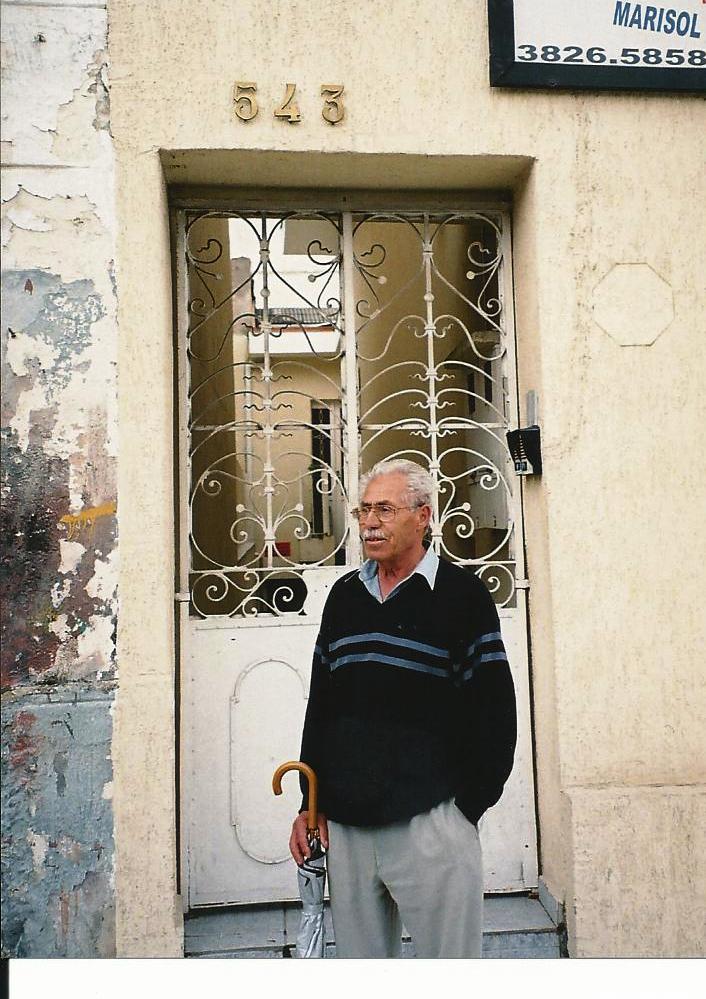
But at number 543 we stop and he smiles again – this is the entrance to his house. Just a white door with decorative iron panels. We were so tempted to ring the door and ask to look around but neither of us had the courage. It was enough just to be there.

He smoked a cigarette and was thoughtful for a moment. I tried to take photos quietly and unobtrusively, of the street, of the surroundings and of my dad. But it felt vaguely like taking pictures of the gravestones at a cemetery.  

Back in the city centre, in a crowded corner of the Praca di Repubblica, stands the Edificio Italia. It was built to honour the thousands of Italian immigrants who contributed to the wealth of Sao Paolo and hosts the Circolo Italia – the Italian Club.  The foundations of the Edificio Italia, second tallest building in Sao Paolo (46 floors), were being laid just as my father was preparing to leave Brazil. He had always wanted to see the finished product. Now we entered this stylish tower, still modern-looking some 50 years later, and took the elevator to the observation deck. We looked out over 11 million people. Cream, brown and grey buildings as far as the eye could see. Snippets of green but otherwise a vast city in its full concrete, bitumen and plate glass sense.

From this high point of view the city was breathtaking in its own way but not, I would say, beautiful. ‘Overwhelming’ perhaps fits better. Could I imagine arriving as a 20 year old, without knowing the language, without any idea of where to go, who to see and what to do to find work? Without any money, any life experience. Confronted by hundreds, thousands of people and all the associated commerce. It was a sobering thought. Despite the excitement, the thrill of foreignness, of being free from the domestic and sedate life my father had led in a small hillside village, it had to have been terrifying and overwhelming. The pleasure of ogling sophisticated beauties in pencil skirts must have been tempered with nagging thoughts about how he was going to eat the next day.

I quizzed my father – was he disappointed? Perhaps he shouldn’t have come back? There are plenty of schools of thought which tell you, don’t go back, don’t look back.

No, no he wasn’t disappointed. He was melancholy, tired, a little disorientated by the travel. But he was relieved he’d seen Sao Paolo again. It satisfied his curiosity. Perhaps it made his memories far more vibrant and coloured for a moment too.

And now he had a new story to tell of his time in Sao Paolo.